![[personal profile]](https://www.dreamwidth.org/img/silk/identity/user.png) arech
arechОбновлено: А может и не уничтожил. Похоже, что это мошенническая работа. Часть изображений содержит однозначные признаки глубокой модификации. https://arech.dreamwidth.org/99723.html
Оставлю здесь в назидание на будущее - не надо верить всему, что пишут даже под брендом Nature.
--------
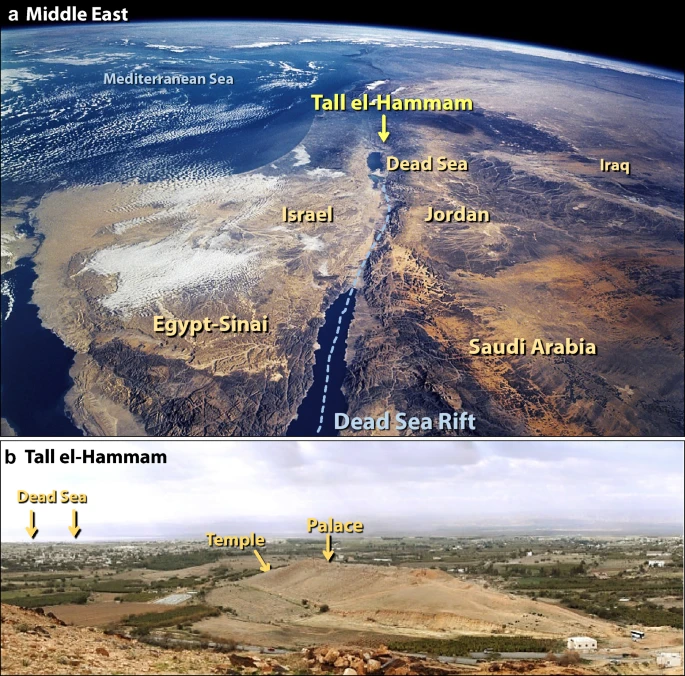
Международный коллектив авторов опубликовал позавчера в Nature мегаработу A Tunguska sized airburst destroyed Tall el-Hammam a Middle Bronze Age city in the Jordan Valley near the Dead Sea где они очень подробно расписывают необычности, с которыми столкнулись при раскопке некогда процветающего города Среднего Бронзового века Tall el-Hammam, расположенного неподалёку от впадения р.Иордан в Мёртвое море. Авторы рассмотрели 10 возможных причин гибели города в ~1650г до н.э. и упадка всей окрестной местности на примерно 600 лет и пришли к выводу, что 8 из них (антропогенная деятельность, включая изготовление керамики, разнообразные виды пожаров, война, землетрясение, вулканизм и удары молний) не объясняют всей полноты найденных свидетельств. С ними полностью сочетается только космическое событие где-то в относительной близости города (точнее, погибли несколько городов и много мелких поселений, просто Tall el-Hammam [TeH] был самым крупным): либо прямой импакт, либо взрыв в воздухе.
(изображение из рассматриваемой работы)
Это очень впечатляющая работа! И читается очень легко без необходимости всяких специфических знаний, с понятными большинству читателей сравнениями. Я прочитал по диагонали - всё как я люблю, подробно до занудности с кучей ссылок и т.д. Конечно, как показывает печальный опыт, читать всегда надо скептически, но тут (а) есть немножко надежды на то, что редакторы и рецензенты Nature обычно делают свою работу хорошо и (б) мне лично это скорее развлекательное чтиво, так что приглашаю просто насладиться отдельными фрагментами работы (не переводил, просто копи-паст, но язык лёгкий):
Из интро для контекста:
Подбираемся потихоньку через плавленую керамику
...через плавленую глину, которой покрывали крыши:
...через направленность повреждений:
Пропускаем важные свидетельства ударного метаморфизма кварца и снова к температурным свидетельствам:
Совсем кратенько про плавленные сферулы, богатые железом, кремнием, сульфидом титана, редкоземельными элементами, наблюдаемые только в слое разрушения и характерные для импактных событий:
Ну и к самому жесткачку:
Вот прям отдельной квотой
Дальше авторы рассматривают подробно возможные причины наблюдаемого. Любопытен вывод относительно последствий атомной бомбардировки:
Далее в сравнении с Тунгусским событием:
Ну и в заключении
Да, да, это уже не первое достоверное свидетельство древнего катастрофичного для Homo Sapiens импакта. ~Первым (?) является Сирийская Abu Hureyra 12,8 тысяч лет назад. В последнем предложении заключения авторы пишут эвристическую оценку таких событий, базирующихся на том, что уже достоверно определено: раз в несколько тысяч лет. И вот тут интересно вспомнить про "известное неизвестное" - сколько ещё сайтов остаются нераскопанными? Сколько сайтов просто сгинуло и свидетельства от них не сохранились? Сколько сайтов хоть и было раскопано, но импактная гипотеза по какой-то причине осталась не замеченной? Мы не знаем ничего из этого, что означает, что "раз в несколько тысяч лет" - всётки скорее очень оптимистичная оценка снизу. Почти точно частота таких событий гораздо выше.
Добавлено: а пейпер по ссылке тоже интересный. Там говорят, что это событие 12,8 тысяч лет назад - не единичное в том смысле, что аналогичные импактные находки, относящиеся к тому времени уже нашли как минимум на четырёх континентах: Европа (включая Сирию), Северная и Южная Америки (Пилауко, Чили - 14000км от Сирии, или 35% окружности Земли) и ещё какой-то (не понял, нет чёткого списка). Одна из работ, на которую они ссылаются вообще называется просто: Evidence for deposition of 10 million tonnes of impact spherules across four continents 12,800 y ago. Объясняют вот так:
(YD == Younger Drias, тот временной период)
Оставлю здесь в назидание на будущее - не надо верить всему, что пишут даже под брендом Nature.
--------
Международный коллектив авторов опубликовал позавчера в Nature мегаработу A Tunguska sized airburst destroyed Tall el-Hammam a Middle Bronze Age city in the Jordan Valley near the Dead Sea где они очень подробно расписывают необычности, с которыми столкнулись при раскопке некогда процветающего города Среднего Бронзового века Tall el-Hammam, расположенного неподалёку от впадения р.Иордан в Мёртвое море. Авторы рассмотрели 10 возможных причин гибели города в ~1650г до н.э. и упадка всей окрестной местности на примерно 600 лет и пришли к выводу, что 8 из них (антропогенная деятельность, включая изготовление керамики, разнообразные виды пожаров, война, землетрясение, вулканизм и удары молний) не объясняют всей полноты найденных свидетельств. С ними полностью сочетается только космическое событие где-то в относительной близости города (точнее, погибли несколько городов и много мелких поселений, просто Tall el-Hammam [TeH] был самым крупным): либо прямой импакт, либо взрыв в воздухе.
(изображение из рассматриваемой работы)
Это очень впечатляющая работа! И читается очень легко без необходимости всяких специфических знаний, с понятными большинству читателей сравнениями. Я прочитал по диагонали - всё как я люблю, подробно до занудности с кучей ссылок и т.д. Конечно, как показывает печальный опыт, читать всегда надо скептически, но тут (а) есть немножко надежды на то, что редакторы и рецензенты Nature обычно делают свою работу хорошо и (б) мне лично это скорее развлекательное чтиво, так что приглашаю просто насладиться отдельными фрагментами работы (не переводил, просто копи-паст, но язык лёгкий):
Из интро для контекста:
... A mound of ancient ruins is referred to as “tel” in Hebrew and “tell” or “tall” in Arabic. The site contains the stratified remains of a fortified urban center, now known as the largest continuously occupied Bronze Age city in the southern Levant1. More than just a mere city, TeH comprised the urban core of a city-state that flourished nonstop for ~ 3000 years during the Chalcolithic Period and Bronze Age beginning ~ 4700 BCE until it was destroyed at ~ 1650 BCE (3600 cal BP)...
... The extensive, ongoing excavations at TeH have continued for fifteen consecutive seasons since 2006, involving principal investigators assisted by graduate and doctoral students and large numbers of volunteers from across North and South America, Europe, Africa, Asia, Australia, New Zealand, and the Near East2,3,4,5,6,7. In addition to the usual debris patterns typical of ancient cities destroyed by warfare and earthquakes, the excavations of the final phase of the MB II stratum revealed highly unusual materials: pottery sherds with outer surfaces melted into glass, some bubbled as if ‘boiled’; melted and ‘bubbled’ mudbrick fragments; partially-melted roofing clay (with wattle impressions); and melted building plaster. These suggest that the city’s destruction was associated with some unknown high-temperature event.
The ~ 1.5-m-thick MB II destruction matrix also exhibited rare properties not found in the strata above or below it. Sherds from thousands of different pottery vessels were randomly intermixed and distributed throughout the depth of the matrix along with mudbrick fragments, objects of daily life, carbonized pieces of wooden beams, charred grain, bones, and limestone cobbles burned to a chalk-like consistency. At the very least, the nature of the MB II destruction matrix is highly unusual and atypical of archaeological strata throughout the ancient Near East3.
Подбираемся потихоньку через плавленую керамику
...To further investigate the melting point of pottery, we conducted laboratory experiments using an oxygen/propylene torch and thermocouple. After full exposure for ~ 2 min, one fragment of unmelted Ca-rich palace pottery began melting at ~ 1500° ± 25 °C (Supporting Information, Fig. S4). Although the temperature and heat flux were sufficient to melt a small area of the potsherd, the experiment was unable to duplicate the extensive melting observed on melted TeH potsherds. In addition, quartz grains embedded in the pottery remained unmelted. This result suggests that the maximum exposure temperature for the excavated melted potsherds was higher than 1500 °C and the flux rate was higher...
...через плавленую глину, которой покрывали крыши:
...Melted roofing clay was associated with ash, charcoal, charred beams, and burned textiles, which suggests exposure to high-temperature fire. Most of the roofing clay displays imprints of original roof construction material, e.g., straw, plant stems, and leaves (Figs. 13, 14). Typically, the depth of melting is ~ 1–5 mm. SEM analyses indicate that most of the imprints also exhibit siliceous plant components, including phytoliths, parenchyma cells, stomata, and siliceous plant fibers, all appear to be fused into the roofing clay at high temperatures. Scratch testing indicated that the hardness of the plant-imprinted roofing clay was between 5.5 (glass) and 7.0 (quartz) on the Mohs scale.
...
Exposure to high temperatures is inferred to have vaporized the water and carbon from the plant material and then, fused the clay into hard vitrified masses. This process appears similar to that documented for proposed airburst/impact materials at Abu Hureyra, Syria17, and Dakhleh Oasis, Egypt43.
The clay imprints of siliceous plant material are inferred to have been made by biogenic hydrated silica (SiO2⋅H2O). Plants use dissolved silica from soils to produce Si-rich cell walls and connecting tissue that increases the plants’ rigidity, toughness, and herbivore resistance44,45. After combustion, these decay-resistant siliceous structures retain their original morphologies17. This siliceous material can be freed from surrounding plant tissue by fire at ~ 450–550 °C but does not melt at such low temperatures46. Moore et al.17 reported laboratory experiments with an oxygen/propylene torch in which temperatures of > 1250 °C were required to fully melt siliceous plant material embedded in Ca–Al–Si meltglass.
...через направленность повреждений:
In contrast, the destruction layer exhibits a distinct orientation pattern marking the distinct movement of objects across the MBA-age excavated floors. Out of about 2000 different vessels represented in the palace destruction matrix, most are fragmentary, and not a single one, smashed or otherwise, has been found in its ‘working’ place on a floor or other surface, and instead, nearly all pottery vessels were broken and strewn in a narrow SW-to-NE orientation spanning up to 10 m. On the rare occasions when intact or nearly-intact ceramic vessels were found, they were seldom found on the SW side of walls, but rather were protected on the NE side of walls, often tilted to the NE and embedded in the destruction matrix. For example, the excavators uncovered an MBA-age food preparation room in the palace with more than 150 separate pottery vessels (some shown in Fig. 15). Shattered MB II potsherds were strewn across the palace floors from SW to NE, nearly always located within the bottom ~ 20 cm of a churned-up debris matrix that ranged in thickness from 50 to 150 cm. Grains, such as barley, that had been stored in some of the pots, were also distributed from SW-to-NE interspersed among the trail of potsherds.
...
In another notable example, a distinctively decorated pot was found in pieces spread narrowly across ~ 6 m, with the majority of its decorated fragments concentrated against the SW-facing wall of the room. Broken potsherds from at least 50 separate vessels of all sizes have been found on this surface and all pieces were strewn in the SW-to-NE direction. Figure 15b shows three examples of shattered pots with potsherds strewn in narrow paths across > 60 cm in a SW-NE orientation. Before being excavated, they were embedded in pulverized mudbrick from the destruction layer.
This pattern of directionality was also observed for larger objects. Within the sealed, undisturbed MB II context of the palace, excavators uncovered a heavy saddle quern (weight: ~ 400 kg or 880#; dimensions: ~ 90 × 50 × 40 cm). Made of dense local stone and used for grinding grain, the quern was found toppled from its dirt pedestal and tipped on its side on the floor of a food preparation area (Fig. 15a). The geometric axis of the quern aligns with the SW-NE direction. Barley grains that had once been on top of the quern were found carbonized and strewn across the floor ~ 1 m to the NE between the overturned quern and the SW-facing wall, suggesting SW-to-NE movement (Fig. 15a). Radiocarbon dating of carbonized wood and grain from this floor confirms ~ 1650 BCE (~ 3600 ± 50 cal BP) as the date for the destruction event.
...
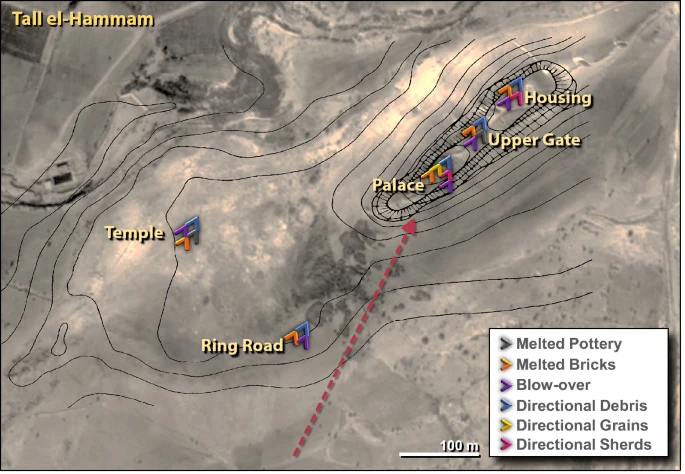
Over a brief span of seconds, a high-velocity, debris-entrained shock wave arrived from the SW, demolished the mudbrick walls of the city, blew over the fallen walls, severely abrading (sand-blasted) the top surfaces, and deposited thin laminations of pulverized mudbrick, fragments of crushed building plaster, limestone spherules, ash, and charcoal, typically 20–30 cm thick (Fig. 16e). The wind demolished the portions of walls and ramparts that extended higher than several courses of mudbrick. Along interior walls, melted mudbrick, broken pottery, wall plaster, charred beams, and other interior debris were pushed against the SW-facing sides of walls that were typically 60–70 cm thick (Fig. 16c), filled the remaining space with pulverized debris (Fig. 16d), and blew the remainder off the tall to the NE. This sequence of fallen walls, capped by blow-over layers, appears to have occurred nearly instantaneously because there is no evidence of erosion or passage of time between the top dark layer, the blow-over layers, and the underlying debris matrix. Significantly, above the destruction layer, there is no evidence for extensive human occupation at TeH for ~ 600 years. Instead, gradual sediment erosion and redeposition buried the entire destruction layer.
(изображение из рассматриваемой работы)
Fig 17: The directionality of debris across the entire TeH site. Color-coded arrows indicate the type and direction of six types of debris. Red dashed arrow and colored arrows mark the movement from SW to NE across excavations that span an area of ~ 58,000 m2 (~ 480 m long by up to ~ 240 m wide).
Пропускаем важные свидетельства ударного метаморфизма кварца и снова к температурным свидетельствам:
Crystalline quartz melts between 1670 °C (tridymite) and 1713 °C (cristobalite), and because quartz is pervasive and easily identified, melted grains serve as an important temperature indicator. At TeH, we observed that unmelted potsherds displayed no melted quartz grains, indicating exposure to low temperatures. On the other hand, most quartz grains on the surfaces of pottery, mudbricks, and roofing clay exhibited some degree of melting, and unmelted quartz grains were rare. Nearly all quartz grains found on broken, unmelted surfaces of potsherds were also unmelted. On melted pottery and mudbricks, melted quartz has an estimated density of 1 grain per 5 mm2.
Melted quartz grains at TeH exhibit a wide range of morphologies. Some show evidence of partial melting that only melted grain edges and not the rest of the grain (Figs. 22, 23). Others displayed nearly complete melting with diffusion into the melted Ca–Al–Si matrix of pottery or mudbrick (Fig. 22). Melted quartz grains commonly exhibit vesiculation caused by outgassing (Figs. 22, 23), suggesting that those grains rose above quartz’s melting point of ~ 1713 °C.
...
... Melted > 50-µm-wide quartz grains on the surfaces of melted pottery and mudbrick from the TeH destruction layer indicate exposure to these unusually high temperatures > 1700 °C...
Совсем кратенько про плавленные сферулы, богатые железом, кремнием, сульфидом титана, редкоземельными элементами, наблюдаемые только в слое разрушения и характерные для импактных событий:
... the spherules and meltglass at TeH must have reached temperatures greater than ~ 1300 °C, most likely involving brief exposure to ambient temperatures of ~ 2500 °C, the melting point of iridium. These temperatures far exceed those characteristic of city fires and other types of biomass burning. In summary, all of this evidence is consistent with very high temperatures known during cosmic impacts but inconsistent with other known natural causes.
Ну и к самому жесткачку:
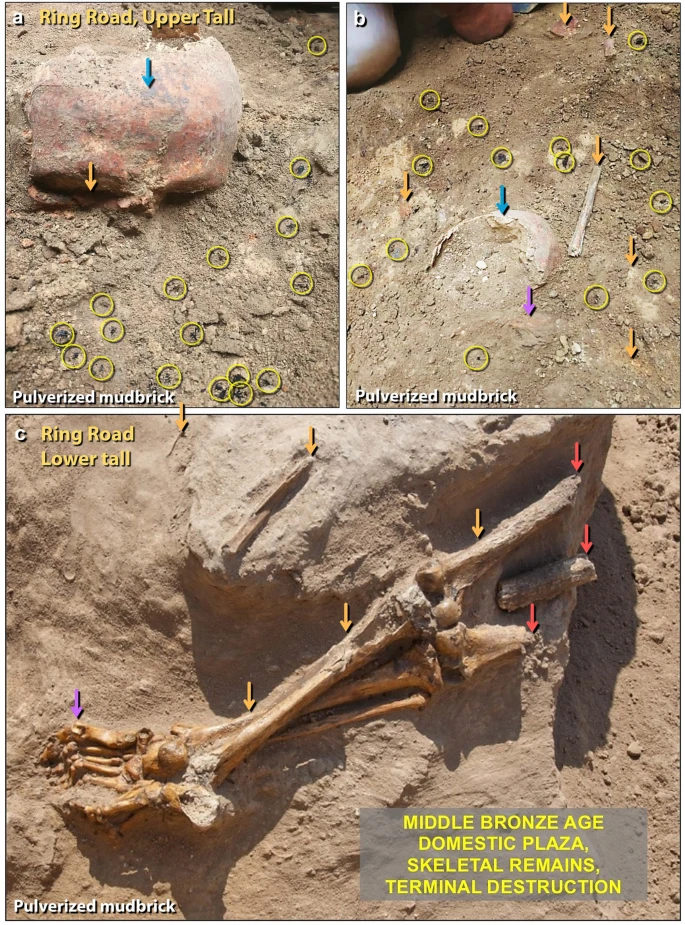
If the MB II destruction event at TeH was of sufficient magnitude and abruptness to be fatal for human inhabitants, as the evidence indicates, human remains should exist in the MB II layer. Indeed, human skeletal remains of sufficient size to be positively identified were found on the upper ring road that encircled the upper tall between the MB II defensive fortification wall and the outer wall of the MB II palace. Two human skulls were found about 20 cm apart (Fig. 44a, b), adjacent to a portion of a pelvis and a likely arm bone fragment. One skull was missing the mandible, and the right orbit was crushed about 50%. The second skull fragment consisted only of the upper dentition and lower half of the right orbit. Only two or three rib fragments were found and no other long bones were recovered. The forensic evidence suggests that the two bodies may have been decapitated, dismembered, and disarticulated. The record indicates that most of the bones had been shattered into small pieces and mixed into a matrix of pulverized mudbricks. Currently, it is not possible to determine if the small bones are from humans or small mammals, but their proximity to identifiable human bones makes it most likely that they are human. If so, only ~ 10% of the combined original bone mass of both humans is present as observable fragments within a 75-cm radius from the skulls. The remaining 90% of the two skeletons are missing and assumed to have been destroyed and/or located further away in the sediment matrix.
(изображение из рассматриваемой работы)
Human bones in the destruction layer. (a) Photo of a disarticulated skull found near the palace on the ring road around the upper tall. The right eye socket has been crushed (orange arrow). Skull is embedded in pulverized mudbrick containing numerous charcoal fragments (yellow circles) and is stained with ash commonly found in the destruction layer (blue arrow). The orange tint of the skull suggests it was exposed to temperatures > 200 °C141. (b) Rear view of the same skull in panel ‘a’ (blue arrow) near the second skull (purple arrow) and numerous disarticulated, fragmented human bones (orange arrows). Charcoal fragments at yellow circles. (c) Lower torso from the ring road of lower tall (orange arrows), and other disarticulated bones. Bones show evidence of being burned (red arrows); the rest of the skeleton is dismembered and disarticulated. Hyper-flexed toes (purple arrow) are consistent with either perimortem or postmortem exposure to high temperatures.
These skeletons were found on the roadway around the upper tall, where the road was 3–4 m wide. The top of the nearby rampart was several meters wide. The remains were found at a depth of about four meters below the modern surface, well-sealed and undisturbed beneath archaeological sterile strata. The bodies had been rapidly entombed by pulverized mudbrick containing abundant ash and charcoal. No weapons were found associated with the skeletons or evidence of damage by weapons, and neither body showed any indication of exposure to scavengers. Although humans can be mortally affected by earthquakes, volcanism, and warfare, these bone characteristics, both individually and collectively, show no evidence that these human deaths were caused by such events. Furthermore, even though these bones were found in close association with large charcoal fragments, the bones lack evidence of direct exposure to fire, except for the extreme upper ends. Radiocarbon ages of the surrounding charcoal (~ 1650 BCE) are contemporary with those elsewhere in the destruction event.
We also searched and found human bone fragments in palace bulk sediments, ~ 15 m away from the skeletons on the ring road. We quantified bone abundance in the fraction using a > 1.2 mm screen (#12 ASTM sieve). The destruction layer was found to contain ~ 19 bone fragments per kilogram, weighing 3.2 g/kg. The largest bone was ~ 2.1 cm long × 0.8 cm wide (average size of bones = 0.6 × 0.2 cm). In nine other samples, three above the destruction layer and six below, no other bone fragments were observed. After excavating nearly 100 squares (0.36 ha or ~ 1% of the site), researchers have found ~ 10 partial human skeletons, out of an estimated city population of ~ 8000 people2. However, dozens to hundreds of broken and disarticulated bone fragments have been found in each of the 100 squares but these were too small to be conclusively identified as human or animal.
During Season 6139, excavations were conducted in two 6-by-6-m squares along the ring road of the lower tall. Both squares revealed a significant abundance of disarticulated and fragmented human skeletal remains in the MB II destruction layer139 (Fig. 44c). In one square, three partially intact skeletons were found. All bones observed were embedded in a loose debris matrix composed of pulverized mudbrick, ash, and charcoal (Fig. 44c). There are no indications of intentional burial, scavenging, accidental death, violence, or battle damage.
Two osteologists examined the bones of two adults and one child139. Disarticulation of the skeletons was generally severe, and for the adult skeletons, only leg bones were preserved. For one skeleton, ~ 10 cm of the ends of both femurs showed evidence of charring. The remaining skeleton was represented by many fragmented bones found in the surrounding matrix. Metatarsal bones were abnormally hyper-extended (i.e., joints were over-stretched) and the proximal phalanges were hyper-flexed at almost 90 degrees to the metatarsals. The right knee joint of one skeleton also was hyper-extended139. In a nearby child’s skeleton, the legs were hyper-flexed backward and the knee joints were disarticulated. Another skeleton was found buried in a crouching position with the hands raised to the face, a posture commonly adopted for protecting the head, as occurred during the volcanic eruption at Pompeii140.
...
We also observed a 3.5-mm-long charred bone that had been splashed with meltglass (Fig. 45). In one case molten sediment had partially melted and mixed with the bone, flowed, and cooled in place. Previous experiments by Moore et al.17 suggest that such melting occurs at ≥ 1500 °C.
...
A medical doctor (co-author T.W.) inspected the human bones and concluded that the injuries occurred perimortem, including damage to the eye socket of one skull. We propose that the individuals represented by the bones were violently torn apart by a powerful airburst/impact, leaving only a few hand and foot bones still articulated and unbroken. It would not be possible to duplicate these injuries and disperse the bones as found in this layer by warfare or by accidental falls from a great height, e.g., off the adjacent rampart. Although tornadoes (max winds of ~ 512 km/h or ~ 318 mph) can cause bone breakage, organ damage, and disarticulation (Supporting Information, Text S3), they are exceedingly rare in Jordan or Israel and typically of low intensity. In any event, no known tornado has been shown to burn bones and break them into small fragments.
Вот прям отдельной квотой
The most severe known injuries to human bodies result from the impact of airborne high-velocity objects, such as during explosions and tornadoes (Supporting Information, Text S3). In addition, the ground-hugging blast wave from an airburst/impact would be laden with high-velocity missiles, including sand, gravel, pulverized mudbrick, plaster fragments, potsherds, broken branches, and shattered timbers. At tornado-force wind velocities and extremely high ambient temperatures, these missiles would be capable of incinerating/stripping flesh and crushing bones. Current evidence suggests that the human mortality rate at TeH was very high, so that most likely none of the ~ 8000 inhabitants survived.
Based on the distribution of human bones on the upper and lower tall, we propose that the force of a high-temperature, debris-laden, high-velocity blast wave from an airburst/impact (i) incinerated and flayed their exposed flesh, (ii) decapitated and dismembered some individuals, (iii) shattered many bones into mostly cm-sized fragments, (iv) scattered their bones across several meters, (v) buried the bones in the destruction layer, and (vi) charred or disintegrated any bones that were still exposed.
...
Дальше авторы рассматривают подробно возможные причины наблюдаемого. Любопытен вывод относительно последствий атомной бомбардировки:
Even though an atomic bomb blast is not applicable because of the historic absence of atomic explosions in the area, an atomic blast produces a wide range of melt products that are morphologically indistinguishable from the melted material found at TeH (Fig. 51). These include shocked quartz64; melted and decorated zircon grains (Fig. 51a, b); globules of melted material (Fig. 51c, d); meltglass containing large vesicles lined with Fe-rich crystals likely deposited by vapor deposition (Fig. 51e, f); spherules embedded in a meltglass matrix (Fig. 51g, h). Also, atomic detonations can replicate the physical destruction of buildings, the human lethality, and the incineration of a city, as occurred in World War II.
Далее в сравнении с Тунгусским событием:
Based on atomic testing and Tunguska, the fireball of both sizes of impactors is estimated to have expanded to ~ 1 km in diameter195 and reached temperatures exceeding 300,000 °C in the center175, many times higher than the surface of the sun (5500 °C). Both impactors would emit an intense thermal pulse (> 45 cal/cm2) that radiates at the speed of light, providing enough heat to melt silicate and other materials162,175. Temperatures would remain higher than the melting point of quartz (1713 °C) for > 25 s175, sufficient to produce meltglass. As the base surge (shock wave) propagates outward for a few seconds, it also provides sufficient heat to melt the surfaces of mudbricks, pottery, roofing clay, and plaster196,197.
The physical evidence from TeH suggests that ground temperatures briefly rose above 1850 °C, setting flammable materials on fire. These temperatures are far above ~ 150 °C that is considered lethal for humans, leading to a nearly 100% fatality rate of exposed humans194. In summary, the impact models that range from 12 to 23 megatons presented in Supporting Information, Tables S10, S11 are consistent with the observed evidence at TeH.
...
The damage at TeH appears similar to but higher than that of the well-documented airburst at Tunguska, Siberia in 1908. A supercomputer-generated model of a hypothetical 15-megaton airburst at Tunguska was developed at Sandia National Laboratories by Boslough197 (Fig. 53). He wrote that when a bolide explodes in the atmosphere, a high-temperature jet of ionized gases and impactor fragments reaches Earth’s surface at high velocity, excavates unconsolidated sediment, and expands radially outward in what is sometimes called a ‘base surge’. Surface temperatures rise higher than the melting points of silica-rich materials, and the surge’s radial velocity can exceed the speed of sound (1225 km/h or 761 mph). Radiative and convective heating can transform surface and excavated materials into meltglass101. Svetsov162 computer-modeled the airburst of an 80-m-wide impactor and found that radiative fluxes from the blast were sufficiently high to melt ~ 0.5 cm of surface sediment at > 1700 °C for a duration of ~ 20 s. This closely matches the half-centimeter-thick melting of mudbricks, pottery, and roofing clay observed TeH, making a hypothetical Tunguska-class airburst a plausible scenario. Even though the Sandia computer model has large uncertainties, the modeled scenario accounts for all the evidence, including the destruction of thick mudbrick walls at TeH and Jericho (Table 2).
Ну и в заключении
An unusual 3600-year-old charcoal-rich destruction layer at Tall el-Hammam marks the sudden abandonment of a Middle-Bronze-Age urban center in the Jordan Valley close to the north end of the Dead Sea. Across the 30-km-wide lower Jordan Valley, 15 other cities and > 100 smaller villages were simultaneously abandoned at the end of the Middle Bronze Age to remain largely uninhabited for ~ 300–600 years. The remains of this ancient city and adjacent areas appear to be unique compared with those of other times, pointing to the occurrence of some highly unusual catastrophic event. The primary purpose of our research here has been to attempt to resolve this mystery.
...
We investigated 14 major lines of evidence to investigate this unusual event: (i) shocked quartz grains that formed at pressures of ~ 5–10 GPa; (ii) vesicular pottery that melted at > 1500 °C; (iii) mudbricks and roofing clay that melted at > 1400 °C; (iv) high salt concentrations in sediment, including melted KCl and NaCl incorporated into melted mudbricks; (v) diamond-like carbon (diamonoids) that formed at high pressure and temperature; (vi) soot, charcoal and ash, indicating high-temperature fires; (vii) Fe- and Si-rich spherules, some of which melted at > 1590 °C; (viii) platinum, melted at ~ 1768 °C; (ix) iridium at ~ 2466 °C; (x) zircon at > 1687 °C; (xi) chromite at > 1590 °C; (xii) titanomagnetite at > 1550 °C; (xiii) quartz at 1713 °C; and (xiv) low remanent magnetism, a counter-indicator of lightning strikes.
We considered and dismissed 8 of 10 potential processes (Table 3), including volcanism, warfare, and tectonism, that can account for at least some but not all of the evidence. We conclude that the only plausible formation mechanism that can account for the entire range of evidence in Table 3 is a crater-forming impact or a cosmic airburst, most likely somewhat larger than the 22-megaton airburst at Tunguska, Siberia in 1908. The data also suggest an airburst occurred a few kilometers SW of Tall el-Hammam causing, in rapid succession, a high-temperature thermal pulse from the fireball that melted exposed materials, including roofing clay, mudbricks, and pottery. This was followed by a high-temperature, hypervelocity blast wave that demolished and pulverized mudbrick walls across the city, leveling the city, and causing extensive human mortality. An important observation is that although local sediment can melt at ~ 1300 °C, that is a minimum temperature but not a maximum one, a conclusion that is supported by the presence of embedded minerals that melted at temperatures of up to ~ 2500 °C. In addition, anomalously high salt content in the debris matrix is consistent with an aerial detonation above high-salinity sediments near the Jordan River or above the hypersaline Dead Sea. This event, in turn, distributed salt across the region, severely limiting regional agricultural development for up to ~ 600 years.
Regarding this proposed airburst, an eyewitness description of this 3600-year-old catastrophic event may have been passed down as an oral tradition that eventually became the written biblical account about the destruction of Sodom. There are no known ancient writings or books of the Bible, other than Genesis, that describe what could be construed as the destruction of a city by an airburst/impact event. This airburst/impact hypothesis would make Tall el-Hammam the second oldest known city/town to have been destroyed by an airburst/impact event that produced extensive human casualties, after Abu Hureyra, Syria at ~ 12,800 cal BP17. Similarly small but devastating cosmic events are expected to recur every few thousand years189, and although the risk is low, the potential damage is exceedingly high, putting Earth’s cities at risk and encouraging mitigation strategies.
Да, да, это уже не первое достоверное свидетельство древнего катастрофичного для Homo Sapiens импакта. ~Первым (?) является Сирийская Abu Hureyra 12,8 тысяч лет назад. В последнем предложении заключения авторы пишут эвристическую оценку таких событий, базирующихся на том, что уже достоверно определено: раз в несколько тысяч лет. И вот тут интересно вспомнить про "известное неизвестное" - сколько ещё сайтов остаются нераскопанными? Сколько сайтов просто сгинуло и свидетельства от них не сохранились? Сколько сайтов хоть и было раскопано, но импактная гипотеза по какой-то причине осталась не замеченной? Мы не знаем ничего из этого, что означает, что "раз в несколько тысяч лет" - всётки скорее очень оптимистичная оценка снизу. Почти точно частота таких событий гораздо выше.
Добавлено: а пейпер по ссылке тоже интересный. Там говорят, что это событие 12,8 тысяч лет назад - не единичное в том смысле, что аналогичные импактные находки, относящиеся к тому времени уже нашли как минимум на четырёх континентах: Европа (включая Сирию), Северная и Южная Америки (Пилауко, Чили - 14000км от Сирии, или 35% окружности Земли) и ещё какой-то (не понял, нет чёткого списка). Одна из работ, на которую они ссылаются вообще называется просто: Evidence for deposition of 10 million tonnes of impact spherules across four continents 12,800 y ago. Объясняют вот так:
The geographical extent of the YD impact is limited by the range of sites available for study to date and is presumably much larger, because we have found consistent, supporting evidence over an increasingly wide area. The nature of the impactor remains unclear, although we suggest that the most likely hypothesis is that of multiple airbursts/impacts by a large comet or asteroid that fragmented in solar orbit, as is common for nearly all comets. The YD impact at 12.8 ka is coincidental with major environmental events, including abrupt cooling at the YD onset, major extinction of some end-Pleistocene megafauna, disappearance of Clovis cultural traditions, widespread biomass burning, and often, the deposition of dark, carbon-rich sediments (black mat). It is reasonable to hypothesize a relationship between these events and the YDB impact, although much work remains to understand the causal mechanisms.
(YD == Younger Drias, тот временной период)


